
Over the course of my career, I’ve been involved in a number of personality tests. These are given to help us reflect on ourselves as people, but also how best to interact with our co-workers who may be of a different segment of the given test. I have found these fairly interesting over the years, these collections of observations compiled by people using their specific methodologies – I cannot state equivocally if these are under “scientific” circumstances or not – and how many of these observations accurately offered me insight into a part of myself I could not verbalize. I wanted to describe the various tests and results I’ve taken over the years. I do not intend this as an endorsement of these tests, nor am I saying that you as a reader should take these tests, but to provide what insights I can about them and why I like/dislike them.
TL;DR Personality tests can be fun and insightful, but be willing to be a little skeptical about the results as they’re still mostly considered pseudoscientific. I also fall onto the intellectual introvert, which will be of no surprise as you’ll soon see if you don’t already know.
Gallup StrengthsFinder
Back in 2014 I took two different tests, the first of which was the Gallup StrengthsFinder 2.0 (now known as CliftonStrengths). It was taken as part of an HR event, whereby we were also learning things like emotional intelligence (another book), etc. So, we received the book StrenghtsFinder 2.0 which is where we received our code to actually take the test – yes, this is a paid for test, but you can receive a code from purchasing any number of their books in order to actually take this test, so if there is interest, peruse their offerings to see if anything grabs you.
The results of the test align you to several of 34 “themes” – which are categories “determined by Gallup as those that most consistently predict outstanding performance,” and by leveraging these talents that one is mostly likely to “spontaneously exhibit… in day-to-day behaviors” one should find success all over the place.
NOTE: One problem I have with any philosophy or idea that promises results based solely upon your attitude and/or performing of certain steps is the amount of things outside your control. People can be physically fit their whole lives and die of a stroke or be hit by a bus – things outside their control. People can work hard for a company for decades only to have it collapse around them and walk away with nothing – things outside their control. In every ideology, including anything I espouse here, one must still be vigilant, one must still be ever prepared for change, one must be honest about who they are inside to understand what is within their control…
So, back to the results. At the top rest 4 “domains” to which the 34 “themes” rest in. I’m not sure if these domains existed when I took this test, but I find adding this part of the results interesting enough to share. The test provides you with your top 5 in detail… here are mine (by domain):Strategic Thinking:
- Intellection (1), Input (2), Learner (3)
- Executing: Restorative (4)
- Relationship Building: Relator (5)
- Influencing:
Interestingly, at least to me, this should not be a surprise to myself or anyone that knows me personally – I’m absolutely a nerd for information, for knowledge, but without always a plan for what to do with it. I like to know things for the sake of knowing, and while I used to like to feel like the “smartest person in the room” I’ve learned over the decades that for all I know, I have plenty of friends who know things that actually matter in a day-to-day existence, they take better care of their health, they could survive if shit hit the fan far longer than myself, and they get through their day without even thinking about some of the things I marvel over. We all have our thing and we all must respect that other people have their thing… unless that thing is harming other people…
I’m not going to get into the definition of each of the items – review the associated links for the quick definitions. What I am interested in is the domains of Executing and Influencing. Strangely, I would have expected Relator to be above Restorative, because Restorative is roughly defined as “adept at dealing with problems.” As before, people that know me in reality would agree with me this seems incorrect… I can certainly pick apart a problem, and some problems I know a solution to, but most of the time I am either at a loss of a solution or my impression of the solution is incorrect – which is why I enjoy working as part of a team.
The other piece I find really telling is that I have no upper level strengths in the Influencing category – an irony that this is another new blog for me and I cannot fathom having a real following outside of friends and/or family… the idea that I am trying to influence people with no strength in it is not surprising to me…
The test also offers an action plan, and where this becomes really intriguing to me now is that there’s an alignment to at least one other test that I’ve taken recently, which I’ll go over further down. Basically, this test has been reaffirmed very recently as far as my interest in knowledge and how I handle social interactions.
All in all, I enjoyed this one, but it is a paid-for exercise so I would consider maybe having an employer review it to perhaps offer a training where you work – if such a thing possible. Have someone else pay for it. 😉
DiSC Assessment
This test I’ve actually taken 3 different times at two different jobs, first in 2014 and again in 2018 at one job, then the most recent time was 2019 where I am currently employed. What’s interesting about taking a test multiple times over the years is to see where changes may take place – this one illustrates such a change, but I admit I’m not sure I agreed with it.
DiSC has quite the nerdy history, as it was founded by William Moulton Maston, creator of Wonder Woman, way back in the late 1920s. The first test wasn’t created until the late 1950s by a psychologist, but much like the StrengthsFinder, it was created for businesses and not the general population.
As with the previous entry, there are 4 dimensions to which a person is aligned, and there are terms/adjectives associated to help provide additional clarity as to why you rated where you did within a given dimension. The results for 2014 & 2018 are relatively unchanged (slight increase in my weakest dimension – influence), but 2019 shows a major shift in how this assessment is described as well as my results.
2014 & 2018 results “Perfectionist”
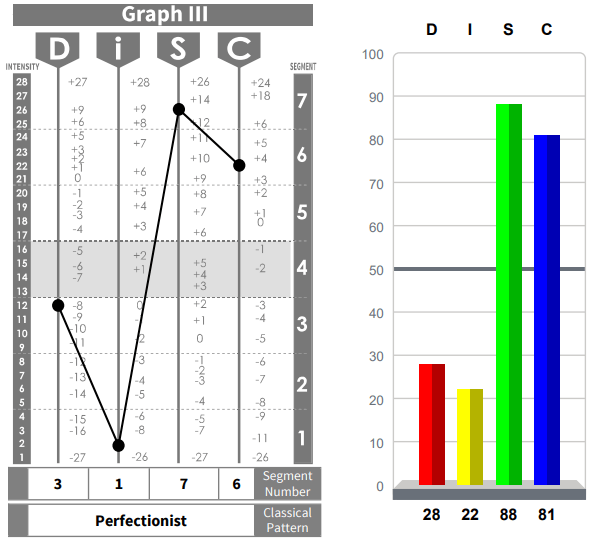
- Dominance (3)(34)
- 2014: self-reliant, calculated risk-taker, self-critical, unassuming, self-effacing, realistic, weighs pros and cons
- 2018: calculating, cooperative, hesitant, cautious
- Influence (1)(18)
- 2014: pessimistic, aloof, withdrawn, self-conscious, reticent
- 2018: reflective, factual, calculating, skeptical, logical
- Steadiness (7)(82)
- 2014: passive, patient, loyal, predictable, team-person, serene
- 2018: patient, possessive, predictable, consistent, steady, stable
- Conscientiousness (6)(82)
- 2014: diplomatic, systematic, conventional, courteous, careful, restrained, high standards
- 2018: systematic, accurate, open-minded, balanced judgment, diplomatic
2019 results
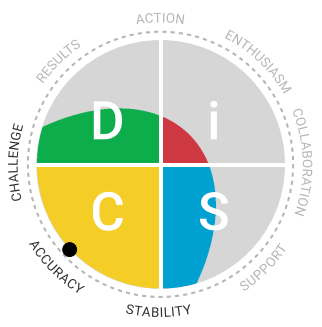
While they no longer seem to rely on the list of terms as in previous years, they do offer some examples of things I likely enjoy:
- Creating efficient systems or procedures
- Providing in-depth analysis
- Emphasizing accuracy and precision
- Working independently
- etc.
I still feel like I tend towards the S segment, especially given my interest in support and stability – I think I still align more towards the C/S instead of the pure C, but the details provided me are still really insightful and it helps provide some potential steps to help me overcome certain obstacles and how to deal with people of different types.
NOTE: It should be understood that these tests should also not cause you to place yourself inside a given box or bubble or shaded area and feel you are stuck by it or fully defined by it. I know this could be tough in a work setting during a seminar where everyone is comparing their results, but they provide you a sort of moment-in-time insight into who you are and this insight can help you learn more about yourself which can be very helpful.
Myers-Briggs Type Indicator (MBTI)
Probably the most popular of these tests is the MBTI. It’s also my least favorite. This is because I’ve always known of its lack of scientific rigor, but as I have given voice to ones above that have had more success in business so has more testing, yet still lack real scientific testing, I think it only fair to provide the MBTI a place here. What’s fascinating about the MBTI is that it became wildly accepted amongst much of the same areas as the previously mentioned tests – which means these all have roughly the same length of time in service to business, etc.
Much like the above tests, the MBTI has essentially 4 overall values you could achieve, but it more broadly categorizes humanity to a total of 16 personality types. When I was in high school I came back as an INTJ, so let’s see how things come out now:
2021 results “Architect”
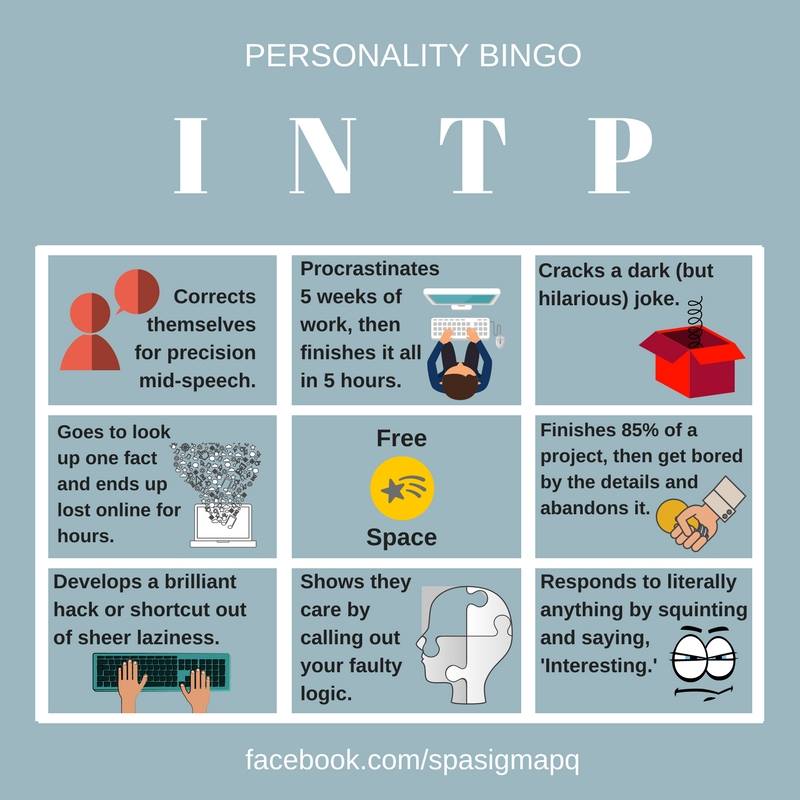
- Introverted (69%) vs Extraverted (31%)
- Sensing (41%) vs Intuition (59%)
- Thinking (55%) vs Feeling (45%)
- Perceiving (67%) vs Judging (33%)
Not too much different from high school… 25ish years ago. Also, this is pretty much what I expected and I’m sure everyone who knows me would, naturally, nod their head in agreement.
The Enneagram
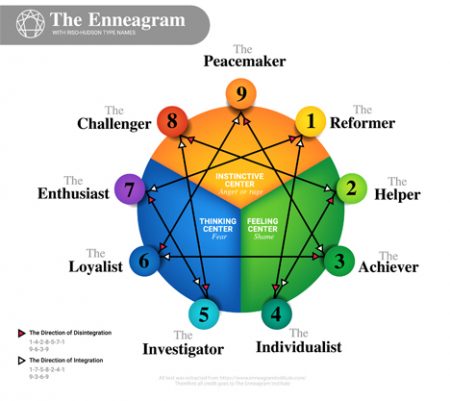
This is one that was introduced to me back in high school but I ignored it at the time. However, a different friend from high school presented it to me recently and I’ve really embraced it. I think it’s because it doesn’t feel as much like being caged or strictly defined as the others – except maybe the MBTI.
At this point, if you’ve read this far, it’s probable you could review the multi-colored, multi-faceted chart above and determine which of them I scored the highest on…
Type 5 “The Investigator” – I know, shocking, right?
The Enneagram, like the other personality tests mentioned here, have not had rigorous testing to garner greater legitimacy. However, as with the others, it’s still pretty popular. While some of its proprietors will suggest it comes from ancient wisdom, in its current form the Enneagram stems from a philosopher in 1915 and really put together in the late 1960s – kind of like the DiSC timeline.
I’ll be exploring this one in greater detail in a later post, so I won’t drone on about it right now.
So, What’s The Point?
That, Dear Reader, is an excellent question. As I mentioned way at the beginning, while these tests do not follow the greatest rigor from an evidence-based scientific standpoint, they can still be insightful and can help you get a better understanding of yourself and potentially offer some suggestions in how to progress further into these stronger dimensions of yourself, look out for pitfalls, how to interact with people of the same, similar, or opposite types, etc. These are philosophical types that lack a religious fervor so they already fall pretty high on my list of workable and relatable ideas. Plus, I don’t take what they tell me about myself or prescribe for me at face value. I’ll discuss in more detail about the Enneagram in a later post because I still currently find it the more fascinating of the taken tests, but it’s important not to get sucked into someone else’s explanation of who you are – “you are the story you tell yourself” goes some adage or cliché of whose origin I’m too tired to really trace, but it’s still such an important concept.
The other reason for this is because it’s really important to know who you are as you relate to yourself… could be worth the time.
 Toothless Philosophies