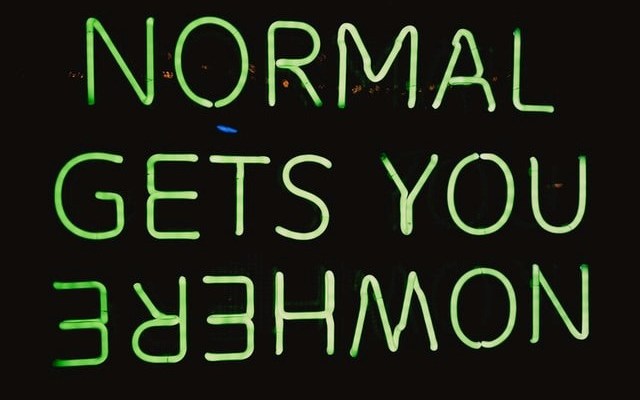
What IS Normal Anyway?
You can Google “definition of normal” and be presented with the Oxford definition:

In terms of expected definitions, this one pretty well nails it. Conforms to a standard. It’s the usual or typical or even expected thing. Yet, this seems lacking to me…
What Standard?
By its very nature, the word “normal” must be used in context, and not just because it’s an adjective. You could say something is “pretty” and assume that it has an appearance or a sound that is pleasantly appealing. “Smelly” or “stinks” in terms of either a smell or an idea, but even without context, the usage of these words presume something unappealing. But, “normal” by itself isn’t clear.
We live in a period of history where we are bombarded with stimuli of all sorts from multiple sources. As I sit here typing on one half of one screen, another entire computer is playing music while my phone rings from a robocaller. I have chat windows, social media, work sites, lights, windows, neighbors, traffic, laundry, heat… I have all these things happening at once – this is considered “normal” nowadays, though, isn’t it?
We fight each other based on lies, conspiracy ideations, media, personal bias… over a disease, over the human-worsening damage to our planetary climate, over origin and identity and religion and politics… we fight each other over our own definitions of what we think “normal” ought to be based on what tribe we want to be a part of. We even fight each other because we’re saying the same thing but differently…
The country I live in talks about ideas like pro-life, but then cuts funding for adoptions, thinks social programs are socialist, is pro-kill the enemy and pro-death penalty – while also espousing a “Christian ethic.” We’re pro-soldier during recruitment and war, then forget about them almost entirely once they return – even using them as test subjects without their knowledge. We’re okay when billionaires exploit their workers and the law to make their vast, selfish fortunes, while ignoring the very people forced into multiple jobs to meet the cost of living. We say not to trust the government while rioting over the big lie perpetrated by the previous administration. We insist that we’re not racist while constantly providing two very different justice systems, by focusing on the fringe instances of violence at BLM protests and ignoring anything else that movement is trying to say. We say we want to keep the government out of our bodies while also fighting to end health rights for half our population. We say “antifa is bad” while supporting a growing segment of a political party who seems pretty bent on actual fascism – but socialism is bad because Venezuela (a dictatorship). We insist on punishing minorities within our population because too many of us find that they are not “normal.” We insist on revealed knowledge only to have evidence slap so many purely absurd claims aside.
Obviously, from a statistical perspective there are things that more closely aligned to a central collective, but why does that mean things that lie outside of that are “bad” if there is no harm being caused to others? Why must we chastise and hate and destroy that which we find different and for no other legitimate reason?
Who Decides What’s Normal?
Unfortunately, we do. Ideally, we would handle this as a society, but since we’re operating on different ideas for “normal” and different worldviews and experiences, this seems an insurmountable task. Numbers or not, we as humans feel entitled to label things as “normal” as we want.
An Example – Gender
Let’s take identity as an example – specifically around the usage of pronouns to describe a person. I find the burden of how one chooses to identify themselves as being on that person and not on the person attempting to identify them. I also think much of the pronoun argument is based on ever-changing and never-consistent definitions, except perhaps by those people who want to ignore it and just make everything statically binary – which is also a problem. When we’re talking about someone who was identified as biologically one gender at birth – the term is “presented” as far as I understand it at this time – but throughout their lives they are compelled to present themselves as being of a different gender, then the expectation of that person is to be able to be referred to as that other gender.
…but, what IS gender? Genitalia? Then the person who has gone through a sex change should be, without question or trepidation, be known as the new gender. Is it the ability to give birth? What about those people who would be “normally” assigned as “female” who are incapable of having children? Are they no longer female? No longer women? What about impotence – are they no longer a man?
We have been forced by language and tradition to think of human identity in such strict terms we have locked the procreative process into how we label each other – but that only works as it relates to the procreative process. Take Thomas Beatie (I know it’s Wikipedia – relax), who was born with the procreative parts associated as “normal” for a female of the human species – which is true from statistical normalcy. By 2008, when Thomas would give birth for the first time, he identified as a man, a male, of the human species. My contention here has been that this is incorrect from a biological perspective, but I’ve had a change of conception about this that I’d like to share.
Thomas Beatie is a person who had been born into this world, called by many different names, and had been expected to do many different things. For those looking from the outside, these things would have been referred to as “normal.” For Thomas, however, they were not. Thomas chose to fight what most people considered “normal” to be who he felt he had to be. Did Thomas hurt anybody along the way? As far as I know no one was killed or maimed or tortured or kidnapped by him, so… where’s the problem in calling him a man? Further, his wife at the time was unable to bear children due to having had a hysterectomy, while he still had those parts – what choice did they have if they wanted to have children?
I think we need to remove this idea of the biology determining the gender title, especially when we have creatures that can procreate asexually or can swap from being one gender to another – including a shift in their sexual organs. Clownfish – NEMO, for crying out loud – is a species that has been shown to swap gender as part of their basic necessity. They start male with a female at the top of their hierarchy, only to have the most dominant male serve the procreative purposes of the female when said female passes on.
What I mean, ultimately, is we’re simplifying a very complex process down to a single word and ascribing it where see fit because of what religion and tradition would consider “normal.” Yet, what we’re doing is positioning people into a little box with expectations that they may not be able or willing to fulfill, and we feel justified in this.
In order to create a human you need the sperm and the egg and then the womb to carry it around, right? Essentially? Then, from a procreative perspective, there’s a person contributing sperm to be introduced to the egg being carried by another person to then grow and be born from the womb of a person (“normally” the egg/womb would be from the same person, but surrogacy already allows that to play out differently).
However, when it comes to identity, the only certainty is that we’re all humans, and if you want me to refer to you as he/him or she/her or they/them I don’t really care. I will, however, balk at things like xim/xer because those aren’t words… My argument there is semantic and etymological in nature… Also, if you are going to be demanding in an entitled way of your gender terminology, I simply won’t talk to you, because you’re clearly unable to have a rational discussion and I expect to be yelled at for absolutely no reason. Understand this is new to a lot of people and be patient.
So… What’s Normal?
Humanity is stupid and reactive and barely deserving of the miracle of its existence. That’s about the most consistent statement about human behavior I can surmise most of the time.
To clarify, I have yet to be presented with definitive proof of a Creator, an Unmoved Mover, a God or deity of any level, but I respect the mathematical impossibility that our existence represents based on our ever-expanding knowledge of the universe.
-The Author
What Should We Then Do?
We should accept that language is evolving and our understanding of ourselves and each other evolves with that. We’re latching on to old ideas with a sense of entitlement that they must remain the same – time to let some of that go.
 Toothless Philosophies