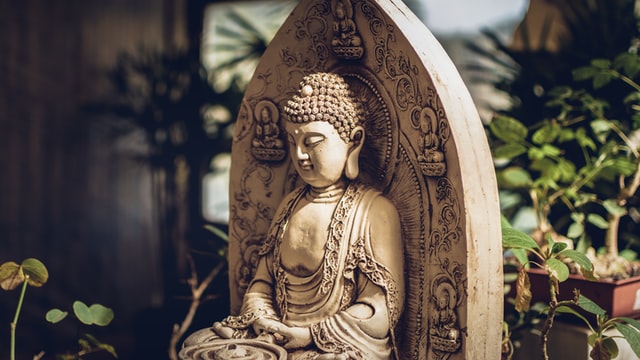
Another entry from my Little Black Book comes the basic tenets of Buddhism: Three Universal Truths, Four Noble Truths, and the Noble Eightfold Path – collectively, Dharma. I will admit that when I was on a journey of self-discovery after my turn from Christianity, Buddhism felt like a really good alternative to me. However, like all religions or philosophies or strict ideologies, I found reasons not to completely embrace it. These reasons, much like other faiths, often fail me because of how many adherents choose to implement their particular faith and not the faith itself. Well, that’s only partially true, but the more obvious mythical and ritualistic elements of a given faith are there for teaching and training purposes, not to be considered factual to the point of distraction. Like any good morality or fairy tale, myths are meant to inspire us and teach us, not force us into a killing frenzy over our imaginary friends… Speaking of which, let’s talk about the Buddha!
The Buddha
Legend has it that, at the age of 29, a prince named Siddhartha Gautama was finally exposed to the idea of suffering in the world. His response was to denounce his royal inheritance, live an ascetic life, and seek enlightenment. He would achieve his goals and sometime in the 6th-5th centuries BCE Buddhism was born. I used the phrase “legend has it” because of the stories attributed to the Buddha (“enlightened”) are considered more legendary or apocryphal. Further, he didn’t write anything down. So, much like Socrates or Jesus, I tend to disbelieve they were historical persons. However, much like Socrates and Jesus, the Buddha’s impact on the world is felt as strongly now as when he was supposed to have existed. Let’s talk about just a couple of these topics.
My primary sources are from Professor David Holmes and the Venerable Phramaha Nopadol Saisuta. I chose them for specific reasons:
- A good Google – What makes a Google good? The results.
- Wikipedia – It’s a good first step and can offer some random clarity, but people downplay its application because of the crowdsourced nature of its contents. It’s actually a pretty solid resource, but never rely on your single collection of Funk & Wagnalls either.
- Their positions – Prof Holmes refers to Buddha as “a human being… not a divine being.” This is important to me. It’s one thing to have a hero, it’s one thing to say someone that you see as spiritual inspiration was a tremendously focused person who achieved great things by their determination, it’s another thing entirely to go on about supposed miracles as being sufficient proof or sufficient reason to herald them as a god. Go by the teachings, not by the person – this latter piece is wildly dangerous and any cult we’ve learned about over the last few decades should be sufficient proof of that. Saisuta, an educator in Thailand, put together a very simple yet effective bit of information about these basic Buddhist tenets and offers some additional insight into these same elements without treating Gautama as a holier-than-thou character. To me, these two sources will be sufficient for the purposes of my barely read site. I admit neither are overly clear on how rebirth/reincarnation work, but these are separate ideas to Buddhism.
Three Universal Truths – Tilakkhana, Lakshanas, Marks of Existence
I will admit that these are not presently in my collection, but I wanted to include them here because they server the larger discussion and I feel they are relevant. Also, hand-written books can be changed. I’ve included some of the generic terms for these concepts as well, either the Pali or Sanskrit words (or both) are shown.
- Everything is impermanent – Aniccā
- Impermanence leads to suffering – Dukkhā
- The conceit of “I” – Anattā or Anātman (this one is a pain in the ass… much confusion for me here)
These are wildly giant topics that I could not begin to dive into here, especially given the third bullet point is confusing enough that I had to sort of make my own interpretation of after some further investigation. The idea with that one is something about non-self or non-Self or there is no “I” or some other way to possibly suggest we, as individuals, are not special? I’m unclear. I’m sure this is something I think I can be onboard with once I have greater understanding, but I think I like the idea of what I have proposed. I feel this idea is more about raising our perceptions beyond just ourselves, to remember that there are lots of other people. Yes, the shit we have to trudge through can be horrible, and other people can have it more horrible than you or less horrible or even awesome – just remember you’re part of a larger humanity and everyone will experience their part of it differently. Or, “It’s not about you.” Maybe that also sums it up…
The first two should be fairly simple to comprehend – “things change, and change sucks.” Not sure I need to clarify those any further…
Karma
A word on karma – yes, karma is a word, shut it. I think we in the West have a very narrow view of karma, inasmuch it’s stereotypically used to describe our elation as to the punishment of those who wronged us or who we feel wronged others. It’s a buzzword we barely understand. Saisuta suggests karma is more related to cause and effect in a broader sense, not just in a punitive one.
My issue with karma is the same as my issue with “God’s Will.” Both of these are concepts that leave a bad taste in my mouth – and I’m a fat guy so I know what tastes bad. Both espouse an egotistical opportunity to judge someone else’s situation from a much lower position than we ought to. We treat it as though we know something or that our impression of a situation is somehow correct, when in reality none of us has a complete picture of anything that’s ever happened, including in our own lives. We can use scientific methodologies to get a greater understanding of very specific things, but it’s really not worth our time to have a double-blind test on conversations with people to know if we could have said something different or to record everything in our lives so we can recall the information to then analyze it. The universe is a big place, and everything that is happening… IS HAPPENING. Some of the things that occur we know what’s causing it, other things we’re making real strides to understand it, but most of the time we’re relying on our failed memories and our interpretations of those memories to be accepted as abject reality.
Essentially, I don’t buy into karma…
Four Noble Truths
My truly basic understanding of Buddhist concepts – which I would suspect any actual Buddhist to correct me had I had any in the audience – brings us about to the Four Noble Truths, whereby the concept of suffering, of dukkhā, gets expanded. After all, this is probably the most difficult of the Universal Truths because it’s the only thing we have any ability to do anything about. We can’t change the impermanence in existence, all we can change is how we perceive it.
- Dukkhā – Suffering exists. Pretty simple.
- Samudaya – Suffering has a cause. The cause of suffering is attachment to the impermanent.
- Nirodha – Suffering can cease. By combating and ultimately defeating your attachment to the impermanent, you can achieve nirvana.
- Magga – The Middle Way, or the Eightfold Path. This is how you achieve non-attachment, how you end your suffering.
Now that I’m writing about this and reviewing everything with more patience, it’s almost funny to me to think that the basic concept of Buddhism could be boiled down to “lower your expectations.” That’s not what this is about, but in some respects that’s how this all reads to me. If you understand that change will happen, that change will be unpleasant, and that you have no control over that change, then the more you simply expect the unpleasant and unexpected the less it will surprise you and the more prepared you will be emotionally. Oh, and if it’s a good thing – great, but next time it may not be.
I’m absolutely oversimplifying it, but I personally think there IS a simplicity to it. I think it aligns with Stoicism in some regards as well, about keeping track of what you can actually control and responding accordingly, while everything else… you have to let some things go because you’re holding onto a memory of something you had no control over anyway. This doesn’t work in every situation, but the concept can also be equated to forgiveness or letting go because it doesn’t benefit you to keep reliving it. People who have been abused or been through war… this is a much harder path to walk because their burden is so much greater, but the circumstances that brought them to that place of unimaginable pain and horror was out of their control.
Nirvana
We’re back with another commentary on a different topic – nirvana. While Prof Holmes doesn’t feel Buddha was a god, he does still hold the prince in very high regard, to that point of hero worship, of essentially placing him into the arena of being a savior to humanity long before the Christ Child came. One of the issues I have with Buddhism is this idea of enlightenment, that the ultimate goal of every Buddhist is to be above everything in this place of bliss and clarity. This doesn’t exactly scream humility, which I think as equal a virtue as patience – in many respects, I think they’re the opposite sides of the same coin. Patience is about how you perceive others, but humility is how you present yourselves to others. If you can be both patient with where a person is at while also maintaining the humility of knowing you’ve been in a similar place, you remember that we’re all still humans and we’re all operating on different levels for different reasons. You may have the ability to see the world from a higher perspective, but that doesn’t make you above everybody.
Noble Eightfold Path
Time for more Pali / Sanskrit!
The Noble Eightfold Path, or the guidelines for ending our personal suffering, is a further division of three basic groupings:
- Sīla – Moral virtue. This has two fundamental principles, namely that all living entities are equal (principle of equality) and what is essentially the “Golden Rule” of “do unto others…” (principle of reciprocity). Contained therein are three parts of the Path
- Samma Vaca – Right Speech. This is something I’ve seen throughout the various religions or philosophies of my personal studies, but the idea here is to avoid lying, criticisms, condemnation, gossiping… “If you don’t have something nice to say…” or “Is it true, it is kind, or is it necessary?”
- Samma Kammanta – Right Action. Herein contain the Five Precepts: Do not kill, steal, lie, misuse sex, or cloud your mind using intoxicants. The misuse of sex is interesting, because much like Jesus, Buddha said nothing about same-sex relationships.
- Samma Ajiva – Right Livelihood. In supporting yourself financially, keep to the Path.
- Samādhi – Meditative consciousness. This is essentially mental development, but a huge focus of Buddhism (and basically every other Indian philosophy) is meditation. You could further argue things like prayer are meditative.
- Samma Vayama – Right Effort. Promote thoughts of good and not of evil. This is primarily within yourself. Prevent qualities that would violate the Path, nurture those that are congruent to the Path.
- Samma Sati – Right Mindfulness. Be introspective to your entire body and mind, striving ever to overcome cravings, biases, and ignorance.
- Samma Samadhi – Right Concentration. Meditate.
- Prajña – Wisdom. This is really what you’re shooting for.
- Samma Ditthi – Right Understanding. Know that actions have consequences, even into your next life.
- Samma Sankarppa – Right Thinking. Focusing on the goal of the attainment of wisdom and ultimately enlightenment is why you walk the Path.
The parallels here with other faiths and philosophies should be obvious to those who practice them, especially the Western handling of the Abrahamics. I further expect many of these to crop up in later posts about religions, as I seem to be drawn to them along with other philosophies.
Conclusion
I enjoy these concepts and think they are areas we could attain to without the added mysticism or worship of another human being (who may not have existed – I’m not entirely convinced). Obviously, there are lots more to the Buddhist faith than just these initial thoughts, but I think these could be beneficial tools to your day-to-day. As with all of these, try what you think might work, honestly give it a chance, be kind to yourself and others, then keep what works.
 Toothless Philosophies