This is a question I started asking after I left high school, when my grip on faith was in freefall. The inspiration for the question came from a film series by a Christian pastor and intellectual (at least in my eyes) named Francis Schaeffer (timeline). At the time I respected his style greatly – I even took my beard inspiration from him and a Christian musician/lyricist I loved, Mark Heard. Anyone who knows me now, however, knows I no longer aspire to the things either man professed.
The question of what’s good or bad or evil isn’t as simple as many would believe. The statement “thou shalt not kill” works if you don’t want to be a cold-blooded murderer, but defending yourself can even accidentally end in the death of someone else, never mind what it takes to be a soldier in the trenches, in the foxholes, on the beaches. We’re faced with choices basically all the time. When we’re dreaming it’s largely subconscious, but decisions are made nonetheless. The outcome of those choices end up being beneficial or detrimental, generally speaking.
Now, before I get too far down the rabbit hole, I do want to specify that I have a difficult time assigning most things as good or evil, but there are obvious exceptions. I think evil is easier to define because most of humanity would agree on such things without much desire to understand why such things take place. Things like child abuse, genocide, cannibalism; the most heinous of the human activities involve the causing of severe trauma at the very least, and can lead to such unspeakable horrors already mentioned. I’m sure there are others I can’t think of, but these should speak to the level of actions I would consider as outright evil.
One of the reasons this topic is important to me is because I was raised in the faith, as already mentioned. I was taught to believe in God, in Jesus, in the Bible. I was taught the Ten Commandments were good, but also Love thy Neighbor. For my upbringing, the exposure to the Christian faith was essentially Protestant, and any ideas outside of that were essentially nonsense and of Satan, the Great Deceiver, Corruptor, Liar.
Cracks started to form the more I dug into the texts which I was supposed to believe in their entirety. One of the first things that really got me was this idea of Godly Jealousy. Humans were not allowed to be jealous or envious, but it was okay if God did it, because God was good all the time. This was really odd to me, because it felt like a “do as I say, not as I do” approach, which even in high school I thought was really weak as an argument. I still did what I was told, I didn’t want to get in trouble, but that also brought up weird thoughts for me about the idea of Hell and eternal punishment alongside free will. Another time perhaps.
I’ve since grown to a level just beyond cynical about the idea of God being good, but only because of things like asking Abraham to kill his son, the egomaniacal allowance of Job to be tortured, wiping out everyone on the planet except for one person’s family, commanding the slaughter of the Amalekites, and sending his Son to be killed so we didn’t have to perform all the old blood rituals. God’s body count in the Bible is a couple million by what estimates I can find, whereas the character known as Satan is 10. Difficult for me to reason I should consider such an entity as always good.
Even though I have way more questions about this God entity, the other side of this discussion has been this idea that those who do not believe in God cannot possibly be moral for they have nothing to base it on. The obvious retort is to just say “which god”, but given the people I interact with and watch online it can only be the God of the Bible, and more generically that Christian one for which I was raised to believe in. Which specific version of that God was another question, but that’s only because of all the denominations and global schisms within the faith over the last couple millennia. This is another nonsensical detail to try to hash out. I should point out this is not a question or statement from all Christians, but those who engage in this sort of rhetoric, at least in my experience, have all been professing that particular faith.
To be honest, given my upbringing, I thought this was a fair question. At least for a while. It coincided with the more tame question of what do I believe in now that I don’t have faith in God. It would take me some time to realize that my answer to that is why do we need to believe in anything in the first place. As children, we believe in our parents, our community. We live that culture, it becomes such an engrained part of us it can be difficult to see anything outside of that as good or beneficial. It can be the same when raised in a religion.
If we have no reason to question these things we can get stuck in the groupthink, in the idealization of all we learned. This can become quite dangerous, quite detrimental, if left truly unchecked. We see examples of this in the news quite a lot: extremists of various religions causing violence of mass scale, political extremists who believe their patriotism is the only way to make things right, religious organizations or families hiding child abuse and financial crimes. People who believe they are doing “good” or at least pretending they’re doing the good they believe in, all the while hiding behind their so-called beliefs to be horrible, even evil.
So, what do I believe then? What do I think is a good way to view morality, and how can I base it on something other than a religious belief? Thankfully, I’m not the first person to be asked this question, nor am I the first to come up with a potential answer. However, I’m not going to go through all the people and ideas that came before me. What I will do is try to clarify some terminology before diving into my still growing personal philosophy.
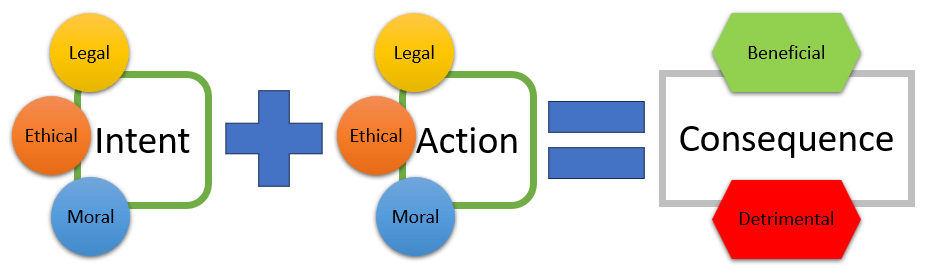
For me, I think choices are actually beneficial or detrimental rather than good or bad. This is a semantic point, to be sure, but I think it works. An action is just an action, and it is both the intent and outcome that determines whether an action is something we were glad took place.
In the case of killing, if the intent and outcome is to cause undue harm to another living being without the intent of survival, this would be an overall detrimental action. Circumstances cause variations, which could push this to something more towards evil, or accidental at the other end – which speaks more about the intent part of the equation. If you were interested in killing yourself, I would argue that while you should have the bodily autonomy to make such a decision, you’re causing undue harm to yourself and to those who love and care or even just like you. Again, circumstances vary and there may be very good reasons to take this step, but that’s not a topic we can flesh out here. Just, communicate with the important people in your life, and seek outside assistance if this is on your bucket list.
To take this to another semantic level, I think the intent + outcome equation also has implications on other areas, specifically legal or ethical or moral. I understand that ethics and morals are, by definition and study, interchangeable terms. However, I’ve often found that the term “ethics” often applied to vocation, like being a doctor or a lawyer or a politician, and “morals” tied primarily to religious or philosophical ideology, so to my mind these were segmentations of the same basic idea of goodness. Legal, on the other hand, is based on the laws of the land – what’s on the books. Simple, right? Well, let’s see.
If we refer to the least controversial subject ever, abortion, there are implications in the aforementioned areas. As an example, there exists a young woman who is pregnant. For the sake of this example, let’s say she was planning on getting pregnant and had a calendar built, coordinated with her doctor, to know the exact day with which to be impregnated by her husband. During a routine checkup with said doctor, it’s determined there’s a severe complication like pre-eclampsia because she was almost 40 and had complications with a previous pregnancy and, it turns out, also had an undiagnosed issue with her kidneys. There was an immediate risk to herself and the fetus. It’s now week 12, and the only way to save the mother, to guarantee her survival, is to perform an abortion.
From the doctor’s perspective, they have an ethical obligation to save the life of the mother. The legality of performing abortions in the state they are in are between 12-15 weeks. However, this particular doctor is also Catholic and has a moral opposition to abortions. The intent of the doctor in this scenario was to help this woman carry a child to term, but is now faced with a situation that has a solution that is both legal and, I would argue as a doctor, ethical because it will save a life instead of most likely losing two lives. The moral dilemma is, of course, ending what they consider to be a life with intent rather than trying what they can to circumvent this lethal obstacle.
This example is to illustrate how a decision is influenced by these three areas, and why a person may be conflicted with what they believe to be real merit.
What wins, though? Which of the three areas should we consider the most important, the most compelling, when trying to make a decision? I wish I had the answer to that. Every choice bears a consequence, and while most of our decisions will be so innocuous as to not require a second thought, the illustration above shows that at least some professions are faced with life-altering situations that need a decision to be made quickly.
As the illustrated choice bears permanent consequence, let’s take a look at the three areas to get a sense of some influencing factors. At one end we have the legal perspective. As already indicated, they’re in a state where abortions can be performed between 12-15 weeks. Currently, in the US, there are four such states that have such regulations, so the procedure would be legal. While the general consensus in the US is that fetal viability is roughly 23-24 weeks in, this example posits the fetus could not exist outside the womb because of its gestational age. In terms of saving life then, ethically, there is only one currently viably living person to be saved. Morally, however, we’re talking about one of the thorniest subjects this country still faces, thanks in no small part to the Supreme Court. I have some strong opinions on this, but that’s not for now. Morally, this doctor has a given ideology they follow which also has strong opinions about abortion, so they are opposed to performing the one action that would prevent the death of the currently viably living person. What should this doctor then do?
Now, I know that I am a middle-aged, white, overweight, cis-gendered, non-OB/GYN father of two, so my opinion on how to handle anything involving pregnancy should be taken skeptically at best. That said, I think, given the equational nature of what I’m suggesting, the moral choice of that doctor would be to find another doctor. Again, the intent has switched from providing care that would bring a pregnancy to term to now saving the life of the mother. This may feel like that doctor is betraying their Catholic faith, but they also took an oath to save lives. Not only is a second opinion likely necessary in this situation, ethically and maybe legally (this is actually an issue in other countries), but if the only actual solution is to perform a task they are unwilling to perform, then finding someone within their practice or hospital is part of their ethical duty. Their moral obligation may compel them to believing there is another way, but their morality should not then be used to commit to a decision that will most likely kill a currently viably living person and the potential person living inside.
Look, I never said this would be an easy topic, which is why it’s taken me years to come to this point. I think decisions can be really difficult and can be very taxing and can have lifelong effects on the person making the choice. Existence, however, isn’t fair.
How do you apply this stuff in your own life? Great question. Easy… easy stuff. Hmm.
Legality is fairly simplistic. You don’t necessarily have to be a lawyer, but simple things like stopping at stop signs and red lights are a great start. I’d argue that, ethically, you are operating a vehicle in your capacity as a driver, so you should want to do your best in that situation, though I accept this particular situation leans more in favor of the other two segments. Morally, I’d like to think your ideology is such you’re not going to try playing Carmageddon down Main St.
Here’s a real basic chart to further illustrate my overall point. I don’t think we must always labor on this premise, but I think when a decision becomes difficult for you to muster up a solution, this may be of help. I know this looks literally like a basis for something similar to consequentialism or even an opposing deontological ethic like Kant, but I can assure I don’t know enough about either to make that claim.
As I continue to develop this idea, please, at the very least, do your best to be as polite and empathetic to one another as possible. Learn as much as you can, too. The more you know, the less scary reality can be.
 Toothless Philosophies