NOTE: The bulk of this was started way back in January of 2024… I’m so far behind…
- Who Is Oxfam?
- The Guide
- The Power of Language
- Feminist Principles for Language Use
- Gender Justice, Sexual Diversity and Women’s Rights
- Migration and Refugee Rights
- Race, Power and Decolonization
- Conclusion
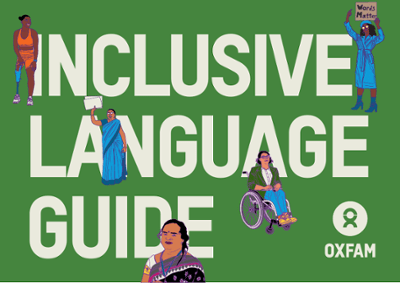
One of the YouTubers I follow discussed a document Oxfam put out March 2023 titled the “Inclusive Language Guide” (link). I’ve been wanting to discuss the problem of gender identification for a while now, and having a document that has all these terms gathered together will be very helpful.
As mentioned previously, as far as I am aware, the collective terminology for myself is that I am a middle-aged, divorced, father of two, cis-gender, heterosexual, white male.
Who Is Oxfam?
Excellent question! I love the engagement. Oxfam was formed in 1942 as the “Oxford Committee for Famine Relief” in response to issues of starvation during WWII. According to their site, Oxfam International was formed in 1995 and has 21 member organizations in a lot of different countries. Their history suggests they have done a lot of good in the world. However, before we get too far into the pocket of this seemingly worthwhile organization, they are not entirely above reproach. I’m not going to go into every issue here, but I don’t want to pretend that I’m shilling for them. What’s at issue is various specific groups who work for Oxfam who are to blame and not Oxfam itself – this is still to say that Oxfam needs to be better about keeping their house in order, though I admit I’m not sure how. It’s difficult to be a perfectly moral organization when so many countries determine their morality so differently, and when you have people who care very little about any semblance of morality and do terrible things. Until those people are caught how do you know what they’re up to? Other organizations that espouse a certain amount of moral authority have been proven time and time again to not only employ but protect actual monsters, so in terms of who’s doing what with more veracity and seeming impunity, Oxfam’s not high on my list of offenders..
The Guide
The PDF itself is 92 pages long and looks more like a well-put together slide deck than a document. It has a very colorful table of contents to help you understand where they’re coming from, why they’re doing this, and to let people know they may not like everything they read. Ye old “trigger warning.” Perhaps not so incidentally, I think people on all sides getting “triggered” by language – yes, it can happen. Certain topics bother me to hear or think about, but I feel like this specific term is more problematic than it means to be, or at least it’s used to flippantly to make it less impactful and more… insipid? Anyway, let’s take a look at the big headers.
- The Power of Language
- Feminist Principles for Language Use
- Disability, Physical and Mental Health
- Gender Justice, Sexual Diversity and Women’s Rights
- Migration
- Race, Power and Decolonization
NOTE: The Oxford Committee for Famine Relief is not using the Oxford Comma. Tsk. Tsk. I know it’s not required, but… ironic.
The Power of Language
I know the old adage for us in the US has been “sticks and stones…”, but as a kid who got made fun of and picked on and beat up, the words last longer. They roll around in your head, and if you’re already dealing with something like depression, it just feels like external support of your internal beliefs. I’m not saying that we need to not talk about certain things or we should kill comedy, I just think it’s possible to at least understand that there are not always limits to the hurt our words can cause, and not everyone who says something wrong is out to get you. Both sides need to understand each other and make certain exceptions to their “us vs them” mentalities. It’s not always a war.
I’m going to take this direct from the guide: “Language has the power to reinforce or deconstruct systems of power that maintain poverty, inequality and suffering. Choices in language can empower us to reframe issues, rewrite tired stories, challenge problematic ideas and build a radically better future…” (pg. 5)
One of the other related reasons language is so important is how you can use it to dehumanize and praise others. As stated above, if you on an individual level already have issues with how you see yourself, someone telling you how much they support you is easily as meaningful as telling you how much they hate you, lots of times for just existing and having a trait they specifically disapprove of. Now, apply that to entire groups of people; people who are already outcast by their given social order, possibly even friends and family. It creates division, sure, but it breeds distrust and has led to violence – even to the greatest violence we’ve ever seen as a species. Words have consequences.
Feminist Principles for Language Use
I’ll admit I’m unclear why this is titled as “Feminist Principles” specifically and not something more inclusive, but I’m also a white male so it could just be a specific point I’m missing. What I appreciate about this section is how they’re not suggesting any of these things as “set rules and should not be viewed as restrictions” (pg. 11). There’s an understanding about context and audience; I’m a big fan of context in these discussions, which I hope to explain further.
This goes over some ideas to consider when having a conversation, making proclamations, writing blog posts, etc. Things like trying to not make “sweeping statements” about groups or communities of people, consider that the way in which we have done things up to this point regarding financial resources could and should be disrupted, avoiding inflammatory commentary that could lead to violence, and generally being inclusive about other humans. Language grows, as either new things become known or old things are allowed to poke their head out of the dirt they’ve been subjected to give us real reasons to rethink how we use certain terms. Sure, sometimes we end up with words like “ain’t” in the dictionary, but sometimes we end up learning something about subsets of humanity we’ve not known about or just ignored.
What’s interesting about subsequent sections is, at least to me, they’re both a brilliant example of how language can be used to further the causes of human cohabitation and the rise of potential understanding and subsequent peace for all of us, and cynically a touch of, “Really?” I’ll pick a couple from each section and given my honest opinion of them.
Disability, Physical and Mental Health
NOTE: The Oxford Comma would not apply here, incidentally
Ableism (pg. 17): This a term I’ve only recently started to understand, but what the guide provides is an interesting point to consider for a lot of what this guide is about: the concept of what’s “normal.” If we had perfect statistics about every single person on the planet throughout time, we could potentially categorize what’s statistically expected under given circumstances, but that still wouldn’t change the fact all people have their own things they struggle with and/or love about themselves. Somewhere along the line, too many people forget we’re all people. Phrasings to avoid in this vein include “is afflicted with” or “suffers from” or “is a victim of,” among other more obvious ones (I’d like to think) like “crippled”, “AIDS victim”, or “normal.”
Some of the additional clarity in these related pages can, at times, be long-winded and feel more patronizing than progressive. An example being “deaf person” vs “deaf” (pg. 19), where the former is the preferred phrasing and the latter is, well, not preferred. I think it’s one thing to say someone who legitimately cannot hear is “deaf” while someone yelling it in someone’s face that they’re “deaf” are two totally different contexts worth taking into consideration.
Another example being “person with short stature” or “with restricted growth” (pg. 21) to describe someone short or a person who has dwarfism. Now, I know the idea is that words like “midget” are obviously reprehensible, and “dwarf” can carry connotations all their own, and I think “little people” must have lost favor – which I’m not upset by, but we again come back to some sense of context, and someone who may have dwarfism is short in relation to yourself at the very least, so maybe just “shorter than me” would suffice?
Or, alternatively, maybe it’s not worth mentioning at all. I know we have this obsession with labeling and categorizing, but some of the things we label and categorize are better left between that person and their physician, family, friends. Maybe it’s not up to us to know what to call someone other than their name. Honestly, there are non-white cultures who refer to each other and “Uncle” or “Auntie”. I don’t know that I understand all the reasons behind it, but there’s something compelling to me about thinking of each other, to some extent, as extensions of your family. This obviously becomes a problem for people who would not identify in that traditional male/female dynamic, but it’s the family bit I find kinda hopeful.
Other forms of this I do appreciate, but I do admittedly enjoy a bit of semantics here and there. “In solidarity with” rather than “standing with” (pg. 21) I like better, and not necessarily because it includes people who can’t physically stand. Solidarity feels more actionable to me, more binding of people to a common interest. “Standing up to something” or “standing against something” will likely need to be reframed to meet the more inclusive requirements for those physically unable to stand, but this also seems like an appropriate phrasing – you’re at least symbolically standing up for something you believe in, having yourself be seen, your voice heard. I don’t know, maybe this one isn’t so straightforward.
Lastly, for this section, they offer some suggestions related to suicide (pg. 21). As a person who’s thought about it since they were 10 and only tried about a dozen times to perform the task over the subsequent 30 years of existence, I understand their point about using the word “completed” over “committed”. That said, I also see it as an action, so even though it was historically criminalized and the word committed is often associated with a crime, the word completed is often used in referencing a prison sentence, so maybe this one is being overthought just a little bit as both words can also mean the deed is done.
EDIT: Friend suggested just to use “died by suicide.” I like this better.
Gender Justice, Sexual Diversity and Women’s Rights
NOTE: Pretty sure the Oxford Comma would apply here
This one may be the more inflammatory section, certainly based on what I’m seeing out on the interwebs. Again, I know what I am and how this category should not affect me, but as I am what I am, I think it’s also right for me to express where I understand and where I may have questions or confusions. Context. I want to be more of an ally, but I also have not lived in this space so cannot simply “get it”.
Androcentrism (pg. 24): They admit the term itself is not in common usage – I’ve never heard of it before right now. The overall point goes back to what’s seen as “normal,” and the patriarchal view of existence puts men in the forefront, in the driver’s seat, and will set women aside. Admittedly, this has been categorically true throughout history, with few exceptions. Very few as I understand it. Where this guide wants to lead more feminist and inclusive, I appreciate learning a new term, but I also appreciate the earlier point about trying to disrupt what we’re used to doing. Just because we did this way forever doesn’t mean we should continue to do it. #fuckthepatriarchy
There is a reasonable amount of concern about how people are viewed for the things that they do for work, be it paid or otherwise. Taking care of family members, even children, is still work, it’s still effort, it still takes a toll mentally and physically. It’s not “burden”, it’s work, and should be treated at least in the same category as whoever the bread winner may happen to be.
One phrase I do find some issue with is “forced marriage” rather than “child marriage” (pg. 26). For what should be any sensible person, marrying a child is forcing that child to be wed and any of the subsequent actions therein related. They cannot be willing participants in this transaction and anyone who suggests otherwise should have their lives turned upside down to see what they’re hiding. The idea that some faiths espouse their holiest people as being so good and wonderful while also downplaying that person’s interest in forcing such activities at any age, and the underaged especially, is truly sickening. The reason I’m torn by this is while they insisted “forced marriage” should, basically, cover “child marriage,” I almost want there to be a distinction, because even girls or women of legal age can be forced into a marriage and I think that’s also something we need to take seriously. All child marriages are forced marriages, but not all forced marriages are child marriages. Here’s an overview by the USCIS.
Gender (pg. 26): I’ve been trying to understand more and more about this whole gender thing; hence the title. Personally, I think both sides are putting a lot of energy into potentially the wrong parts of this, but that’s more because of what society bills out as gender stereotypes in their given social structure. The idea of gender being a “social construct” is not lost on me linguistically, but there are also characteristics of human beings that lean towards being a male or female of the species. Right? Maybe not.
Before I continue with the guide, let me see if I can articulate my point. I don’t disagree that there are genders, and that, biologically, it’s my understanding that sexual reproduction requires materials from two parents; the sperm and the egg – probably a better term for this but I’m out of caffeine… What’s confusing to me is this insistence that it thus requires one to be male and one to be female, let alone more specifically man and woman. The reason I am confused is that there are those who cannot bear children for various reasons, I would argue most of which are none of our collective concern. The issues people have with child bearing is between them and their chosen medical professional(s), and anyone else they may choose to share that with.
I think this is largely due not to societal norms, but more directly religious norms, specifically that of the Abrahamics, by and large the most influential set of religions on the planet throughout much of the last couple thousand years – give or take. This is largely due to the spreading of their ideologies by violence, but other such violent groups who held each person in higher esteem did not prove to be as popular amongst believers. Once established, these faiths have become ingrained into a given culture, even in places where the point was to avoid all that. This is not to say other groups are not also patriarchal in nature, that marginalizing women is a more popular sport than baseball, soccer, or cricket, but considering the spread of the various faiths, most notably Catholicism and its related schisms as well as Islam, it’s difficult for me in my curious but still not as educated thought process to attribute this to some larger genetic preference.
In the time since I started this write-up (almost an entire calendar year ago), I’ve learned more about this. Now, I don’t think I’ll ever be an “expert” in the field of gender studies, let alone with a focus on transgender, and as I am not of the LGBTQ+ variety, I’ll never fully appreciate what it means to live as such in a world that fears and hates you. I am still beholden to a certain concern around trans females in violent sports (because of muscle and bone densities NIH and my experience around domestic violence), but my knowledge of the biology of what it means to be a fully-realized trans female is super-limited, and it’s important to know that trans men are also taking testosterone, which other research suggests is a big factor in the density discussion, so maybe I’m just overthinking it a little bit. However, other sports I see little issue, because you still have to train, and even if you have other genetic markers that make you almost predisposed to a sport, like Phelps with swimming (or did he grow into that from all the swimming), you still have to learn how to do all the things. I also get a kick out of watching weightlifters try to outdo people with training, male or female. When someone shows up at a jiu-jitsu studio and challenges students and gets their ass handed to them, I don’t know if I care whether it’s staged or not – kick his ass, ladies. Technique is wildly important. See similar with arm wrestling competitions where bigger dudes don’t have the wrist strength or technique.
The other part of why this particular conversation about trans people in sport is kinda wild to me is the subset of trans people in sport has got to be extremely small. If you think about the subset of people in sport that we don’t think about their gender, then think about the small percentage of people that identify as trans and how small that would make their subset who are in sport… What are we even arguing about? Even where I have concerns, whoever it is should be walking into that ring of their own accord and willing to take whatever chances are afforded them, male, female, trans… They’re not dogs, so likely not coerced… unless you happen to work for Vince McMahon. I guess my point is maybe we’re not focusing on something worth focusing over? #letthemplay
There are also a growing set of studies that align to the notion that a person’s brain is more likely to be associated with their chosen gender identity. I’ll put some links below, but I want to make some clarifications. I’m not trying to suggest that just because your brain is more associated to a particular thing that means it’s a correct thing and we should treat is as nothing more than a trait. Where I get real specific about this is what that thing does to other people. If you’re brain is associated more closely to psychopathy and subsequently murder, that’s not a personality trait or a quirk, that’s legitimately a cause for concern up to and including all sorts of potentially violent criminal behaviors. If you’re brain is associated towards an appreciation for squirrels and their war with the raccoons… maybe you’re a little delusional, but unless you’re strapping suicide bombs to the squirrels and sending them into battle I’m just going to hope you’re otherwise taken care of. So, too, if your brain is more associated as being transgender, guess what? You’re hurting nobody. You may confuse or scare people, but that’s their nonsense, not yours. I know they can make it yours, but that’s because their brains are more associated with willful ignorance, a willingness to express hatred to a person that isn’t affecting them in any way, and the need to find fault with someone who lives in a way they would not.
Some links about gender identity
I have skimmed these, but I think this specific topic requires way more reading, and I don’t think they all agree with each other which should be interesting.
- Brain Sex in Transgender Women Is Shifted towards Gender Identity
- Biological sex classification with structural MRI data shows increased misclassification in transgender women
- Transsexualism: A Different Viewpoint to Brain Changes
- Is There Something Unique about the Transgender Brain?
- Transgender brains are more like their desired gender from an early age
Returning to our regularly-scheduled discussion
Humankind (pg. 27) & People (pg. 29): Honestly, I like these. This seems the simplest to implement in my mind. Sure, it also seems unnecessary, but it’s also important to understand that we’re all still humans, we’re all still people. Now, I know that seems counter-intuitive given all the other places where gender naming is considered important or relevant or necessary, but it’s important to comprehend context and intent. I think it’s relevant when discussing broader topics, but there’s relevance to terms like mankind, womankind, transkind, etc., in a more generic sense of a grouping of people and what may affect them specifically.
Instrumentalism (pg. 27): Not sure I grasp this one. “Undertaking an activity for a practical purpose or end goal, rather than for its own intrinsic value.” I think the example they provide might be more suggestive of my comment about humankind: “As an example, framing work towards women’s economic justice through the lens that it will lead to wider economic growth is often presented to the private sector as the ‘business case’ for undertaking it. However, this risks undermining women’s agency and the social justice approach. It is better to frame women’s economic justice and sustainable business practices as mutually supportive, rather than that they will definitively lead to business profitability or that this is the primary goal.” When you’re specifically trying to call out a thing that is designed to benefit a specific group, calling out that specific group can be relevant and should be considered.
Partner (pg. 28): This has some additional variations, especially where culturally appropriate but would have the same meaning. For me this is the same as humankind, people, or even the singular usage of “they” (from the OED) [future me: this is discussed on pg. 41]. It’s simpler. It can make the mental transition from man/woman, husband/wife, anything of that more specifically-inferred genderisms to the broader “hey, your name and who you are is more important than how I perceive you without actually knowing anything about you.”
AFAB / AMAB (pg. 34): Okay, this one I’ve struggled with since I was first exposed to it, but it’s grown on me. Assigned Female / Male At Birth. When I first heard these, it was a foreign enough concept to me that I considered maybe it was wrong somehow or misguided or… something just seemed off about it. However, when you think about it, none of us asked to be born, none of us asked for the parents we got, none of us asked for the bodies we were born into, none of us asked for the names we were given, none of us asked for anything at the very beginning of our existence – it was all forced upon us, all of it was assigned to us, along with any stereotyping by others or desires of our parents (whatever that situation may have been).
I was bred by accident (unplanned, anyway, like my brother), and formed in the womb with a lot of fear about what I was going to end up as given all the problems of my progenitors. My own mother was supposed to be aborted in 1950 because the doctors were afraid she would have been born somewhere between a vegetable and having Down’s Syndrome (not the way they worded it, but I’m trying to be polite). The Catholic Church told my grandparents that “maybe she was a cross to bear” so they had her. To be honest, they treated most of their kids like crosses to bear so one more didn’t make much difference; as an aside, it can be real eye-opening when you learn the people you thought you knew and looked up to were truly horrible.
We change our looks, we change our names, we change our outfits… these are things we do on a whim sometimes. There’s a myth around trans people being able to just get surgery, or that kids can just go to school and then be forcibly changed to another gender. First of all, that’s some Mengele-level shit and I’m appalled anyone believes that, especially when it’s the Nazis and Christian Nationalists saying it, but that’s for a different time.
Some links about Gender Affirming Surgery
NOTE: For those concerned about the 12-18 yr old range, there are younger girls who not only start puberty at what is considered an early age, but they can also have, uh… an overdeveloped top that can be problematic for them not only physically but socially. I’ve known at least one person who had breast reduction surgery twice by their 30s because of the continued growth and complications it caused. This is obviously another topic I need to do a deeper dive into if I feel like I can somehow explain it properly.
- National Estimates of Gender-Affirming Surgery in the US
- Prevalence of Gender-Affirming Surgical Procedures Among Minors and Adults in the US
- Get the Facts on Gender-Affirming Care
Cis (pg. 35, 35): This one I’ve just taken for granted as meaning people who are not struggling with their gender identities, which is more or less how they define it. “A person whose sense of gender identity correlates with the sex that they were assigned at birth.” The document obviously extends to the Cisgender, but it also includes terms like “Cis-Normative” and “Cis-Normativity”, which feel very much how the average person who doesn’t understand any of this stuff or, perhaps, hates it, would just say “normal” about gender stereotypes as has been rather forced upon us by religions and (often) religiously-inspired cultures. I don’t mind this at all, because I feel this goes back to my point about humankind or man/woman/transkind; it gives a sense that the normative measures taken in society is based around those who are cisgender, just as things like IQ tests and even sports in and of themselves were designed with white guys in mind, or however long the medical establishment studied men when trying to understand women because of various societal and religious norms. This chunk will also coincide, for me anyway, with “Heteronormative” as discussed on pg. 26 of the file.
Deadnaming: This is where I might get into more trouble, and it’s not on purpose. Deadnaming is referring to someone by their name before it was changed. This term is specifically used in relation to trans people and is generally perceived to be a sleight, almost a slur. Now, for us cis/hetero “normies” (please know I’m using that sarcastically), when a woman changes her name as part of becoming married, some people may not be aware of the married name and could still refer to them by their “maiden name” (interesting etymology question answered here & here: “English: nickname from Middle English maiden ‘young girl, virgin’ (Old English mægden), perhaps denoting an innocent or effeminate man.”). This would not be seen as insulting. If a person just changes their name, I’m not sure the statistics on Witness Protection vs. “I hate the way my name sounds”, but in the case of trans people I want to believe context and intent matter. If you’re dealing with someone quite old who has only known you with one name for decades, then the transition for them could take longer because it’s almost muscle memory at this point – even though you may also look different. However, if you’re dealing with someone that you know very specifically will not refer to you as your current name, that’s a little different.
I’ve “deadnamed” a couple of people before but only as a reminder for those who may not be aware of the change. Elliot Page comes to mind, because I had watched Elliot in a number of movie pre-transition and knew them as Ellen. When trying to have discussions with people about the transition, I’d have to use Elliot’s previous name to catch those people up, which I like to think is more than adequate, but once the discussion is had it seems reasonable to then continue to refer to Elliot as “Elliot” and “he/him” or… now I don’t recall what pronouns… whatever pronouns they want to go by. I know a few trans people and I respect that they have new names and a sense of identity that makes them feel more fulfilled in that aspect of their lives. Who am I to do anything but be supportive that they exist as people? One of those people I use their last name still, because back in high school we had too many people with the same name so it just became simpler sometimes to just use surnames, but I don’t pretend that person still has their previous name.
Honestly, I want to think this is okay from a reasonableness perspective, but if there are trans people out there who want to correct me, please do.
A series of other terms exist throughout this chunk, and I think it’s important for those of us who do not understand these to have an appreciation that what we used to call “being politically correct” is, to me, about “not being an asshole.” This isn’t a religion, this is about showing a modicum of respect for your fellow human beings. There really is a lot here and I invite you to actually read through this section yourselves, because trans people, while not new to existence by any stretch, need support as human beings and I could list all the terms here in succession, but I think reading the whys of the terms is super helpful. Pages 33-44.
Anti-abortion/anti-choice/pro-choice (pg. 45 & 47): This could be a whole other write-up, podcast, series of research papers… I’ve stopped using the term ‘pro-life’ when discussing the other side of the argument. Honestly, it’s really only ‘pro-birth’, but that’s a longer discussion or ten so I won’t deal with it here. Using pro-choice is also pretty obviously the opposite side of the argument. I won’t go into my serious lack of knowledge about reproduction here; I’ll do that somewhere else, though, I’m sure.
Speaking of reproduction, several other terms in here worth looking into, but they’re just another set of examples acknowledging that there are people who experience certain biological functions and some that don’t, and generalizing them by the binary system we have in many places just isn’t congruent with reality. This is informative about the world around us as much as it may feel pedantically telling us how to talk to each other.
Before I leave this section, I do want to admit something. Does anybody remember Thomas Beatie, “the first man to become pregnant and give birth to a child?” I think I became aware of this on Oprah, and I admit I was of the thought that this was nonsense, because a man could not give birth to a child. I’ve obviously since changed my tune as more and more facts are brought to my attention, but I feel it’s important to point out I’m not coming at this from some elevated sense of purpose or self or some revealed knowledge. I had to go through this the hard way, too, and I had to be shown what I was thinking wasn’t as simple, wasn’t as binary, wasn’t as cemented, and could actually be harmful to other people in ways I would never desire. I also did not realize that Thomas chose to be pregnant because his wife was sterile. Honestly, I look back at that story and think how much love Thomas had for his wife and how much she had for him. It sounds like it would have been a lot to carry for a couple to go through all that personal upheaval and then the public scrutiny… This is just one example of real people having to face all the unnecessary hate when all they want is what many people want: to love, be loved, have a family, build a life. They’re not murdering people, maybe leave them alone.
There’s a subsection of terms around sexual violence, and for anyone who heard Route Canal 04 I think you know where I stand on that, but what I will say is that using “survivor” is preferred over “victim,” which I’d learned from Law & Order: SVU at some point… This is because those who have gone through these horrible experiences still have to live with it, and it treats them as people who can still find a way to thrive, rather than treating them the same way you would a dead person.
Migration and Refugee Rights
There’s a lot here, and it’s definitely important, but I need to make a statement before proceeding. Up until this point, I’ve honestly been a proponent of the idea of “illegal immigrants” over “undocumented workers,” for the simple fact that if they are here illegally then, by definition, are they not illegal? The answer to that is, rather emphatically, no. A person may be someplace illegally, but that does not mean that person is, in and of themselves, illegal. This is a careful distinction that I will have to mention in a podcast at some point to correct my mistake. See? This is what I mean, this document, while kinda dense, can be most helpful.
I’m not going to go over all the terms here… I’ll try to refer back to it if I do a write-up about the atrocities in Israel against the Palestinian peoples, among other such horrible crimes against humanity. The thing I will say… in the United States, at the very least, there’s been a real distaste for those who have come here seeking asylum, seeking safety, seeking work, seeking hope, and the discussions around this are also very important and should be given more attention. Again, like the trans discussion above, they want what most of us want… and capitalism and fear go a long way to making otherwise decent people sound isolationist. This is… this is so much bigger.
Here are some terms to give you a sense of what I’m referring to:
- Asylum Seeker / Displaced Person / Immigrant / Migrant / Refugee / Stateless Person
Race, Power and Decolonization
NOTE: Seriously, where’s that comma?
Okay, this is another one I’m going to have trouble with. I don’t want to suggest the trans discussion doesn’t warrant as much devotion as this and the previous topic, but there’s so much I’m looking into about this topic specific I have a hard time knowing what to do with what’s here. It goes from pages 60-88, but I will list some terms below for you to be made aware of:
- Anti- all kinds of things & some -isms, BIPOC, POC, Casteism, Colonialism, Environmental Racism, Institutional Racism, Structural Racism, First Nations, Indigenous Peoples, Homeless People, Global Majority / Minority / North / South, Othering, Privilege, Racial Equity, Reparations, White Gaze / Privilege / Saviorism / Supremacy
Conclusion
There’s a lot here, and so much of this could and should be split out into longer discussions, but at the moment this is all I could muster. I do truly believe I have much more to say about the final two categories, but this document is going to be such an important source for me to know how to word things, what things to look into, and to hopefully give real insight into why I stand where I stand. As much as I’d like to build a Page with all these terms and definitions and explanations, I don’t think I could do it justice. It’s worth a review if this write-up inspires you in any way to do so.
 Toothless Philosophies