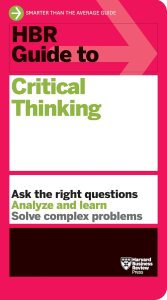
Harvard Business Review has, at present, 90 titles in their Guides series; I have a couple of them, including Finance Basics for Managers. However, the Guide to Critical Thinking caught my attention as I keep running into certain problems with problem solving, especially where it applies to work. I’ve spent decades with a break/fix mentality, allowing others to direct me and set me loose. Well, it’s becoming obvious to me that this can be a detriment to my progress and I’d like to be able to have better insight into where things are and what should be looked at. I know a couple people who have great problem-solving skills, and one of them thrives on solving problems for some insane reason. I guess we all have our thing 🙂
Each of these books, far as I can tell, are a collection of essays or excerpts of other pieces that are designed to help people interested in a given topic. The Finance one was provided at a previous employer, but this current guide showed up in my Amazon “you might like” algorithm, but maybe all the books I’m looking at makes it think I’m trying to solve something. Interesting.
This book is separated out into Six Sections. The intention for this series of posts from me would be to discuss the findings of each section individually. Below are the sections:
- Get In the Right Mindset
- Observe the Situation
- Ask Questions
- Seek Differing Perspectives
- Analyze the Information
- Make Critical Thinking a Habit
Get In the Right Mindset
“Improve Your Critical Thinking at Work”
This chunk is comprised of 3 pieces, the first of which is based on an HBR podcast interview with Helen Lee Bouygues, the founder of the Reboot Foundation, “a nonprofit that helps parents, teachers, and employers think more critically about their problems” (pgs. 9-10). Seems an appropriate person to start with. What follows is a series of questions and answers, but we’ll sample a couple I find the most interesting. I will, however, quote the opening paragraph by Curt Nickish, the author of this piece:
"When faced with a complex issue, leaders often rely too heavily on their own expertise and then jump to conclusions quickly. But doing so can lead to mistakes, missed opportunities, and even failure." (pg. 9)This statement should be fairly obvious, but when we’re all blinded by own our own biases, our own semblance of the self and our ego, it can be missed by everyone at one point or another. Now, I don’t believe that every issue you are faced with will require an intense level of critical thinking. You may run into a problem you’ve solved before so you know how to move that needle, but what you should then be asking is why did this thing happen again. Speaking a little bit from experience, but to repeat the correction without considering going deeper could be a missed opportunity.
Why do you think we lack critical thinking skills? (pgs.10-11)
“One of the reasons why it’s more difficult today is that we live in a world of incessant distractions… When we have a question, we want instant gratification… typing the question into Google… so we don’t have as much time to stop and think. Part of the necessity of critical thinking is having that ability to take a step back and think about your own thinking.”
I know I deal with distractions constantly, both technological and chemical. General anxiety and depression can be most disorienting and can cause me to feel like I’m not providing any value to anyone, including myself and my kids and my close-knit circle. I’m told this isn’t true, but when you’re not thinking about your thoughts and just riding the wave of emotion, you can get trapped in a downward spiral. Hell, you can get trapped upward, too, if you think highly enough of yourself. Distractions also abound, and I crave those, and I’m seeing this happen with my children, too. I think this book may help me to communicate some new ideas to them, which is to talk about metacognition, or thinking about thinking.
And getting better at critical thinking is something we can learn and cultivate? (pg. 11)
“Yes. The opposite of critical thinking is selective thinking… [which] is something you can do relatively quickly because it’s just a reinforcement of your own opinion. People… can get better at critical thinking if they just do three things: question assumptions, reason through logic, and diversify thought.”
A follow-up clarifying question is asked and we start off with the steps. First, take a break. Well, not exactly, but the way this is presented, like going for a walk, is that you’re removing yourself from that in-the-moment situation, removing other distractions from your mind, and you’re off doing something simple and repetitive so your mind can clear up and posit about the situation more calmly. I’ve found this works in my own existence, and I suspect some of you are also aware of this tactic.
Step two is managing your emotions. Admittedly, for the Stoics, this is probably step one, but you could be faced with this before being able to take that mind-clearing stride around the block. Ever been in a meeting or a discussion where things get heated? At a certain point, these discussions become about who’s angrier and not who’s being more sensible. At a certain point, all we hear are each others’ emotions and not the words being spoken. I try to think about item 2 of The Four Agreements: Don’t Take Anything Personally. Now, this is difficult for me in very specific circumstances as I still have a couple buttons that can set me off, but I keep trying to think about it and work on it, and think about how the Stoics handle even those buttons. Yes, I have a lot of things running through my head because I sometimes feel the chaos of the limitations of the mortal mind, specifically my own.
Step three is diversifying thought, or bringing in other points of view. The next couple pages offer illustrations of this, and it’s one of those things that I think many of us further down the chain will often think about. When managers make decisions that we, who will ultimately be doing the work, find utterly ridiculous, it can be a mix of things, obviously, but how many of us feel like your direct managers don’t even understand what we do on a day-to-day basis? When a manager who’s out of touch is asked to make decisions based on “the happy path,” or what Helen would later refer to as “Wishful Thinking Forever” (yes, WTF), it’s partially because they’re often fed information from subordinates and have no real clue how that data came together, let alone all the things that had to happen to have that data in the first place. It’s not always that they’re assholes, because sometimes that’s also true, but they have to see things differently in order to be a manager, just as we at the bottom rungs see what’s really happening in the trenches. Basically, ask questions up and down the chain; you’ll probably learn something.
In Summary (pgs. 14-15)
“Be curious. Ask questions… Pay close attention to the chain of your own logic… Expand your horizon by interacting with people who are not in your existing silo.”
“Beware the Urgency Trap”
I want to open this one with something I think we can all relate to: “Which priority takes priority?”
As before, this article offers up three ways to help solve this problem. I’m going to be real honest, though, I didn’t get a lot out of this one. It’s likely just me, but I didn’t fully comprehend each individual point or understood overall how it avoids the sort of situations that come to mind. To me, the urgency trap is about having to figure out what’s priority, but after a re-read I think the intent is more about when we’re faced with mounting responsibilities and less-than-ideal deadlines, we react in ways which are counterproductive. What sucks is we may not see it.
Do we jump from meeting to meeting without being able to truly take in what was just discussed? Does our communication style come across less engaging and more direct, or, ever worse, agitated? Do we start to micromanage people or tasks in an effort to look “on top of something” when all you’re now doing is stressing out the people actually doing the work? This one can also be difficult because if you don’t feel there’s a problem you won’t think about it, which goes back to metacognition as mentioned above; sometimes we have to step back and think about how we got here.
“Skilled Incompetence” is mentioned, which is a different HBR article, but is roughly described as “…the unconscious tendency to focus on less important work, because we enjoy it or we’re good at it, at the expense of our highest priorities… routine behaviors like this can become accepted norms when we fail to reorganize and challenge ourselves to address them.” I used to work for someone who would always refer to the “long pole in the tent” when it came to a project – what’s going to take the longest, require the highest level of effort, the most resources, etc.? Start there, because no matter how many smaller things you deal with, your whole effort could be irrelevant if that most terrifying task cannot be completed.
This one will take work, and I’m hoping through further reading I’ll be able to more clearly assess how.
“Act Like a Scientist”
“I’ve always been successful doing it this way and never thought about doing it another way” (pg. 25). This is stagnant thinking, but I admit sometimes it may be effective. After all, constantly second-guessing yourself is fucking mental. However, “when skeptics show that ideas underlying practices are wrong, confounding, or even costly, leaders grasp the importance of systematically testing assumptions” (pg. 25).
This final article in the set harkens back to the first article in my mind, especially about relying on your own expertise, your own experiences, above all others. “Acting like a scientist is difficult for leaders because it can challenge their legitimacy” (pg. 26). This can also be true in our day-to-day when we’re faced with someone who may have a different take on how we’re doing things. Plenty of people hate being told what to do or how to do it, it feels like we’re under someone’s control and made to look like we can’t make our own choices. I’ve come to the conclusion that many choices I make are nonsense and I need someone to help point out when I’m being a jackass – sometimes it’s obvious to me so when they DO point it out I can be a little annoyed, but try to remember that the people in your life aren’t always out to get you or make you seem less than you are. Don’t. Take. Things. Personally. Well, unless it’s personal, then by all means.
Over the remaining pages, there are 5 steps to help you think about problems using some elements of “the scientific method… [which] requires intellectual humility in the face of difficult problems and relies on an objective, evidence-based process, rather than predominantly personal insight, to frame and address decisions.”
1. Be a Knowledgeable Skeptic (pgs. 27-28)
A skeptic “will employ reason, demand evidence, and be open to new ideas… this means seeking independent confirmation of facts, placing more value on expertise than on authority, and examining competing hypotheses. Above all, [they] question assumptions. They ask, ‘Why do we believe this?’ or ‘What is the evidence that this is true?'”
This book provides a number of examples within each article where the author will provide an anecdotal justification for their point, but by and large the people are qualified to have more of these anecdotes than any of us. The example here is about Sony revolutionizing their TV market share through asking questions, through not resting on their laurels or taking for granted how things have been. Not for nothing, the Democrats really need to do this if they ever expect to be taken seriously as a political party. In my opinion.
I currently work in compliance, and I generate data and review the findings in order to verify processes have been followed. I’ve learned a lot through this new phase of my career, but most related to this topic is the idea of evidence. As my work is reviewed by people up the chain, and by outside auditors, I need to make sure I am providing as much evidence of what I’ve done and what information I’ve gathered and how these other people can look at everything I’ve provided and almost be able to duplicate the efforts themselves. This has helped me provide even better documentation, because even though I don’t assume people understand what I’m providing them, there are times in the communication that it does look like I’m taking some trivial piece of the process for granted that they would have no concept about. It’s helped me make a name for myself in the organization that will hopefully keep me around until I hit the lottery or find someone to pay me to keep doing this nonsense.
2. Investigate Anomalies (pgs. 28-30)
“When you hear a complaint from somebody, I think it’s healthy to assume there are a lot more people who are unhappy.”
Or even just confused. I’ve been in a number of meetings where I would ask what I would admit was a “dumb question,” only to find out later other people had the same question. I’ve also had people IM me during a meeting because they didn’t understand something, but I knew I only understood it partially, so I’d ask their question for them. I’ve learned to accept when a question is asked that may make me look foolish because the only dumb question is the one you don’t ask. Now, that last little bit of advice should still be used with caution, because not everything you think you want to know is what you actually want to know. Be choosy with where you ask your questions, but if you’re in a group setting, sometimes it’s fine to even be laughed at, because that also shows you who the dickheads might be. But be honest about your confusion and people can generally be helpful. If they’re mature.
3. Articulate Testable Hypotheses (pgs. 30-33)
“To be effectively challenged, assumptions must be framed as hypotheses that can be quantifiably confirmed or disproved… An experiment that produces evidence contradicting a hypothesis allows us to recognize errors in our thinking and judgment… This iterative process of testing and refining ultimately leads to stronger hypotheses.”
So, this once again goes back to not taking things personally. Just because something has always been done one way doesn’t mean it’s the best way. I’m dealing with that right now; there’s a process I was handed and had to make it work on a larger scale. I’ve done that. I’ve gotten kudos for it, people are impressed with what I’ve accomplished and how I’m able to present it. However, we also all agree it’s a living nightmare and needs to be replaced as soon as possible, because it’s the best of a bad situation, which doesn’t mean it’s good. I hear the constant refrain of how much effort I’ve put in, which is nice, but I’m also in 100% agreement that this process was never meant to be scalable.
There is a definite process around how to gather and provide this information, and it does involve offering something quantifiable, something you can work with definitively and not just how you feel about it. You can’t intuit a problem, you generally need to understand how often it happens, how many people it impacts, where in what process is impacted, how it affects unrelated processes (basically how much time does this problem take away from the rest of their jobs), can others repeat your process and produce the same results, etc.
4. Produce Hard Evidence (pgs. 33-35)
This opens with a Feynman quote from 1964:
"It doesn't make any difference how beautiful your guess is. It doesn't make any difference how smart you are, who made the guess, or what his name is. If it disagrees with experiment, it's wrong. That's all there is to it." -Richard FeynmanI feel this should stand on its own in everything we argue about. In many ways, it IS a basic explanation of how burden of proof works, inasmuch the person making the positive claim would have to provide proof of said claim, while the person arguing against the positive claim would not have to provide evidence, largely because you can’t prove a negative, but also because the default position of a thing is that it is not until it is proven that it is.
5. Probe Cause and Effect (pgs. 35-38)
This one opens up with another banger of a general point, though it’s intended for business leaders.
"Relying on assumptions about cause and effect is dangerous... We humans often see connections between unrelated actions and outcomes - confusing correlation with causation - and respond to irrelevant 'noise' factors when making decisions. We also tend to happily accept 'good' evidence that confirms our causal assumptions but challenge and investigate 'bad' evidence that goes against them."Again, this is also pretty relevant in daily life. There is, however, another part of this to be considered, where I admit I’m not sure I fully comprehend. “Finding evidence for ‘A causes B’ gives scientists confidence that what they’ve observed isn’t just a correlation. But a stronger test of causality is the use of counterfactuals, such as ‘Would B have occurred if not for A?'” Where my confusion arises is how to ask those questions; how do you know which of those questions to ask?
I think I have an easy one: Would there be daylight without the sun? Obviously not. Would I have tripped and fell if not for that stray branch? Maybe. Maybe some dirt or leaves could have caused me to slip and fall instead.
I’ll need to ponder this one, look some things up about this. I think the idea, though, is not to rely on the first thing you think you find, but test it out.
In Conclusion
Yes, all of this takes time and discipline, but I see relevance to it in my own day-to-day, not just for work. I think it’s helpful to understand some of these techniques in reference to information we take in and also information we provide. It can be easy enough to prattle on based on your assumptions, but it’s better to offer some details and evidence and to consider if the outcomes or even the causes fit into this logical model of critical thinking. It’s also reminding me to be more disciplined about sourcing materials in some of my more argumentative pieces…
I hope this was helpful and at least mildly interesting.
Brush and either floss or waterpik your skeleton. Seriously.
 Toothless Philosophies