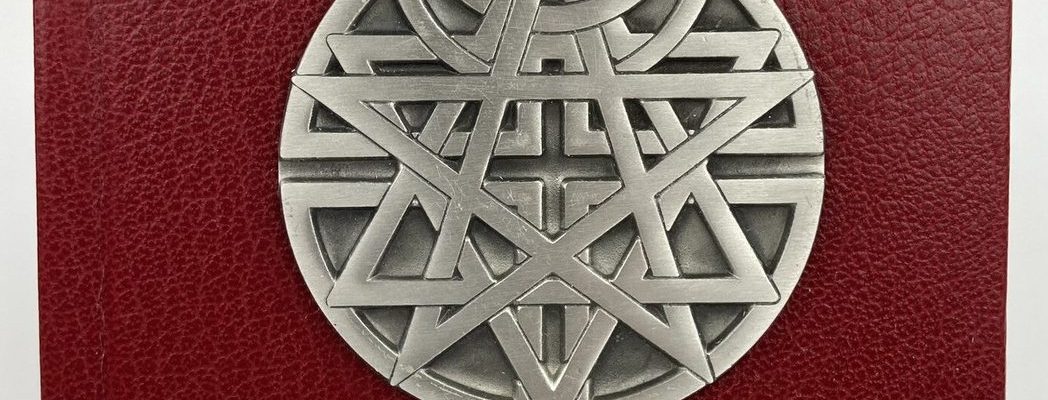
Before we get started I wanted to point out that this album cover has remained in my mind for the last couple decades, though I myself am not a huge fan of the band Disturbed. Just a great design. Syncretism!
While it has been a long time since my previous post, life continues, as does my incessant interest in understanding entirely too many aspects of it. Recently, I’ve been dipping my toes… well, fingers… back into the realm of rings and wearing ones that contain imagery I enjoy without having read too deeply into them at the time. There’s a site that produces some very nice stainless steel jewelry for which I have partaken of entirely too many things given I could not properly size my fingers, but now I have situated myself rather pleasantly on three specific designs. As this has taken place, and there are some other symbols for which I find interesting, I thought it was time to delve into these symbols and see if there is any deeper reasoning for my appreciation of them besides, “I like the way they look.”
I suppose we should start with the symbols themselves.
- The Black Square
By Kazimir Malevich – Tretyakov Gallery, Moscow [link] - Yin and Yang (Yin-Yang, Taijitu)
By Unknown, possibly from Zhang Huang’s 1623 woodblock-printed book Diagram of the Supreme Ultimate [link] - The Valknut
By Unknown, found it on Pinterest, but a Reverse Google Search suggests it’s Sam Flegal, “Nine Worlds” [link] - The Vegvisir with Runes
By Arkadiy Ivanchenko [link] - The Triquetra
By Dan. Yup, that’s all I got. Reverse Search points me back to Dan. [link] - The Celtic Cross
By Pepi. Found it on Amazon. Looks kinda nifty. [link] - The Seal of Solomon as Pentagram
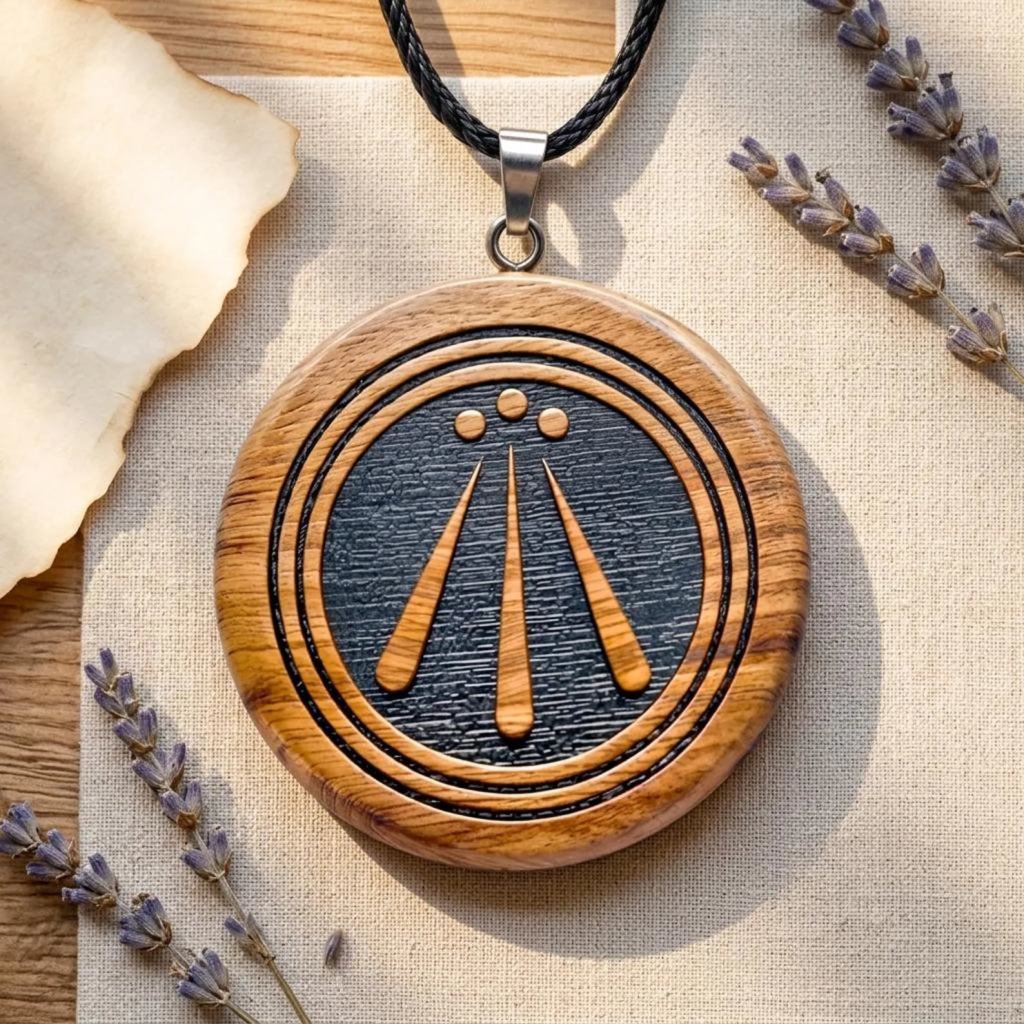
By GTHIC, I own this. This is my dealer. [link] - The Awen
By SineriumDesign. I own this. [link]
Symbol History
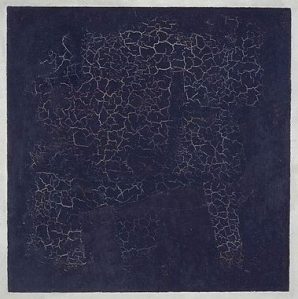
Going down the list, we first have to tackle The Black Square. Admittedly, I wasn’t expecting to find any real context here, but the image you see above is from the attributed painting. From 1915, my finding suggests it was the foundation of the Suprematism art movement. Never heard of it. In fact, when I started down this path of re-ringing my fingers, this black square design over at GTHIC spoke to me right away. Loved it. Never turned back. For me, at the time, it was its simplicity, and while that remains, you’ll see how it’s evolved with the images I’ve surrounded it with.
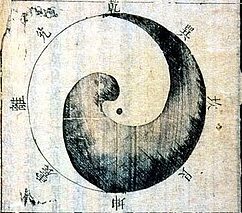
Jumping to probably the most well-known symbol on this list, the Yin and Yang. Hailing from China, it was conceptualized in the I Ching (Book of Changes), but the image we think of was popularized centuries later. The simple idea is the Yin is the feminine or passive side and the Yang is the masculine or active side. To me, and I’ve not ascertained with any specificity that this is the case, this reminds me of several of the Seven Hermetic Principles: Polarity, Rhythm, and Gender most notably.
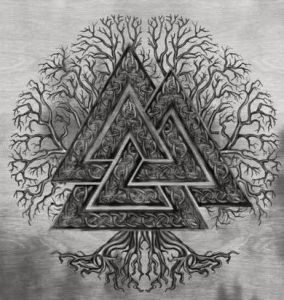
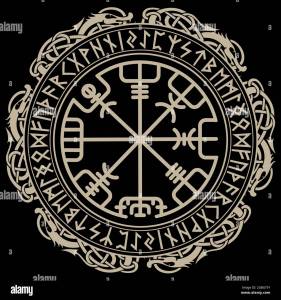
Tackling the Norse-inspired images, this is where we get into more a mix of the old and the new. The Valknut, seen above with The World Tree Yggdrasil sprouting out of it, is fairly old, dating to around the 8th or 9th centuries CE, but its actual meaning remains unclear. Valknut itself is a later invention and means “knot of those slain in battle” as it showed up mostly related to gravestones, burial ships, and it is often next to depictions of Odin and dead warriors. This makes it likely funerary in nature, but to me it also represents those who died heroically and made their way to Valhalla (I cannot attest that this is the case, but based on the 13th Warrior and Thor from the MCU I feel pretty good about my chances). Continuing the Norse-inspired imagery, the Vegvisir is not Viking at all, it’s Icelandic, and it’s from 1860CE. Further, my understanding is it’s actually inspired by European Occultism and Christian Mysticism, and not from the Norse paganism so many people attribute it to, including myself (until I learned different). Finally, we have the Runes. Runes are even more difficult as they date back to 150CE (Elder Futhark) and 800CE (Younger Futhark). I am presently reading a very interesting book discussing these symbols, and finding out the Elder Futhark contained 24 symbols and was used in relation to Proto-Germanic, which in itself is a derivation of the Proto-Indo-European language, while the Younger Futhark, 16 symbols, were actually used by the Vikings as both communication and magic.
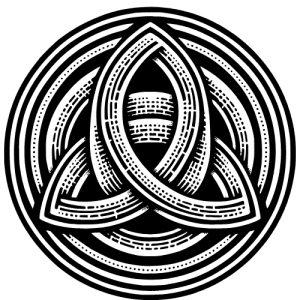
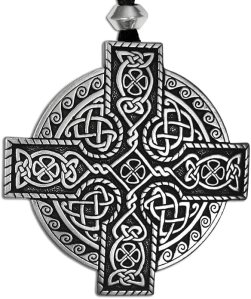
Now we take on the Celtic with the Triquetra and the Celtic Cross. What’s interesting about the Triquetra, and I did not know this until very recently, dates back as far as the 4th Century BCE on early Germanic coins, Indian heritage sites, etc. It wouldn’t be until the 7th Century CE that it was used as part of Celtic Christianity in things like the Book of Kells, and was used primarily to represent the Holy Trinity, though not its only meaning. As for the Celtic Cross, which hails from the 8th Century CE, I’ve been interested in these little creations for over thirty years. No, that doesn’t mean I know anything, just that I like their style, their possibility, the idea that I’m of Irish descent and this artistry is somewhere in my lineage. I’ve never thought of them as the same thing as the instrument of Jesus’ death, though they obviously are. I think their ornateness is what removes the original symbolism from my thinking. They represent sacrifice, sure, but sacrifice with style, with stories.
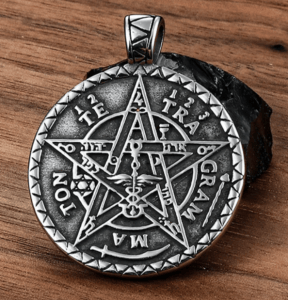
Well, we made it to those images most of my readers would likely attribute solely to occultism, Anton LaVey, Baphomet, etc. I will not fault you for this, but let’s consider the histories. The pentagram itself dates back to Ancient Mesopotamia around 3000BCE, and would jump meaning from society to society, with the Ancient Greeks viewing it as a symbol of mathematical perfection, early Christians thought it represented the Five Holy Wounds of Jesus, and finally in 19th century when French occultist Éliphas Lévi started integrating it into what we now think of it as – a symbol of magick. Finally, we come to the Seal of Solomon, which dates back to the 11th-13th Century CE, and was rooted in various Abrahamic religious folklore. It was originally touted as the ring used by Solomon to command demons and speak with animals, can be represented as either the 6-point or 5-point star, it’s discussed pretty heavily in Arabic and European magic grimoires and the like.
Lastly, we have a Welsh symbol called the Awen, which my research suggests is the divine creative force, inspiration, etc. Much like Yin-Yang, this started as a concept centuries before there was a visualization for us to create neat little trinkets for. Coming from the 6th Century CE, it is an ancient Welsh word stemming from Indo-European (not PIE?) and was treated as divine, poetic inspiration. Perhaps most interesting, its imagery is attributed to a Welsh poet who was also a brilliant forger, and his supposed intention for this was to state it represented the true, unpronounceable name of God.
For anyone paying attention, this is a lot of religious symbolism for someone known to have been rather militant against religion in general for quote a while…
What Do I Want?
I suppose the honest answer is, “I don’t really know, but I feel like there’s something here.” While I did assemble this collection based on “vibes,” and I have been thinking about how to translate the imagery, the symbology, into something meaningful, I wonder if part of why I’m here is because I am searching for something more spiritual in my existence. Sometimes I miss believing in something, even if it’s just nature. I’ve been mildly obsessed with a YouTuber who teaches on the Esoteric, including the Hermetic, the Gnostic, the Kabbalah, a number of the symbols discussed above he goes into great historical detail. He also turns out to be married to a female rabbi and they’re part of Reconstructionist Judaism, which is a progressive system that does lean on Judaism by-and-large, but it’s more naturalistic and less legalistic than one would expect from someone with a long beard and the yarmulke – something he himself says is a reminder that he’s not the top of anything, something else is always above. He’s also a big reason I’ve started toying with some kind of spiritual return, because he has this very basic premise, “I take religion seriously, but not literally.”
I’m not specifically going down the road of the magickal practitioner, but as I consider myself an adeist and not an atheist I feel there’s room here for me to draw upon. I think of theology as philosophy and I take what is useful to me and not the rest – though I may discuss it from time to time. In this way, I believe that my refusal to accept a deity puts me into the camp of adeist, and not someone who is not a Deist (like much of the Founding Fathers were). At any rate, thought is thought, and some of it’s quite useful and quite beneficial while some is downright terrible.
Where I have struggled of late is the simple fact I renounced the religion that raised me over a quarter century ago, and I’ve been down the path of evidence for some time. I have dipped the proverbial toes into some semblance of spirituality, but when it came down to it, I couldn’t find a way to support believing in something without wondering how I can prove it, measure it, demonstrate it. However, and I think I keep coming back to this but I’m trying to figure out if I can make it stick, that’s not the point… One of the arguments I have made to people of belief who have a certain amount of legalism to it is that the idea is it’s the journey, the walk with Jesus more specifically. It’s not about the religion, it’s about the relationship. Now, having grown up in it, I am definitely bothered by the idea of faith being “the evidence of things unseen,” but really only in the context of telling me I must believe the same thing in the same way. I must have the same faith as the faithful in the same way and of the same amount of investment. This is obviously problematic to me as there is no evidence to support this level of attitude.
All this is to say, I still think I want something but I don’t know if I can sustain it beyond the idea of it…
The Idea of “It”
I don’t have some overarching name for this, but I may come back and update it if I find something clever, some word or idea that phrases it in a way most inspirational to me. I suppose I could call it “The Toothless Way” to keep things consistent…
Part I: The Mortal Dyad
There are two symbols here that, to me, represent mortality. One being the Valknut; as it is seen primarily associated with death, to me this is the fate of us all – this is the thing we cannot escape. Concurrently, the Black Square represents a certain amount of darkness, but to me it’s more about an emptiness in life, something missing from the mortal coil. These two symbols are coequal in my mind as both represent loss and a desire to escape. As mortals, we are by-and-large trying to live longer, or at least live better… speaking as someone with a spotty history of self-ending attempts (failed at every turn).
Part II: The Plurality of Existence
As before, there are two symbols revolving around each other like binary stars, Yin-Yang and the Triquetra. Yin-Yang should be fairly simple to comprehend given its binary comingling, but the Triquetra posted an interesting conundrum for me. While it obviously prefers the number three (usually as it relates to the Christian Trinity or life, death, and rebirth, amongst other meanings), when I combine these I get the sense that there are a near limitless amount of combinations of what they might represent, and that everything that is… just is.
Part III: The Triad of Trajectory
Not my best name, but it’s alliterative so I’m keeping it for now. These are all representative of the way out, the way forward, finding the way. Runes had been used at times in divination, the Seal of Solomon more generically represents finding different ideas to help direct you (books, music, movies, etc.) like a map of sorts, and the Vegvisir is the compass that helps you focus on your True North. You cannot predict the future no matter how hard you try, but you can find how others navigated similar waters to keep going forward, never losing sight that this is your path and your journey, and that “any road followed precisely to its end leads precisely nowhere.” Thank you, Frank Herbert.
Part IV: The Duality of Destination
The last two items on the list are the Celtic Cross and the Awen. The Awen is, for me, what keeps me away from the Black Square of Emptiness, from the annoying threat of actual mortality. I want to create, to think, to share, to learn, to enjoy. I want to remember the time when I found nature truly awe-inspiring and felt something deep inside me when I would see mountains and the trees in fall and hear the soft landing of snowflakes and the rains on new leaves and even the sound of water lapping up on the shore… I want to feel, not just think. As for the Cross, my first actual employ was in a book warehouse with my father, where the company sold books primarily to colleges and universities, and I remember seeing a book that discussed Celtic Crosses as story tellers, or story boards, in some way telling stories. Other symbols on this, most notably the Valknut, have been associated with stones that also told stories, so in many ways I keep coming back to this concept. While we’re on a journey, we should not forget where we came from, what we learned, and be willing to share to those who ask.
Another curiosity of this thought is that it’s not a straight path, it’s not steps, it’s a constant struggle, a pulling of these four major elements and the symbols I’m using to help me define them and deal with them. Am I forcing meaning into symbols that may not mean what I want them to? Maybe. Could I have gotten away with this without any symbolism at all? Definitely. So, why have I gone through all this trouble? Because I want to. I feel compelled. I want more from what I have to offer myself and subsequently to those closest to me. I want to believe in and of myself I am worth the effort.
Actually, I was talking with a friend of a friend recently about their own journey, and they said something that struck me in a way I definitely need to spend more time thinking about, “I’m not sure if it works for me, so much as I work for it.” Life isn’t meant to be easy, we’re meant to work at it. Relationships. Education. Vocation. Parenting. Everything is effort. We are not entitled to a good life.
“In order for us to be free, we have to assume our responsibilities… We are going to have to work at it. We have to learn and understand that hard times are necessary for the good times to be here.” -John Trudell, Santee Dakota poet, philosopher, musician, actor, Indigenous rights activist.

